

How the Modern Masters Shaped Our Artists
Reading the work with Art in the Park Director and Curator Sofija Matich
Reading the work with Art in the Park Director and Curator Sofija Matich
Reading the work with Art in the Park Director and Curator Sofija Matich
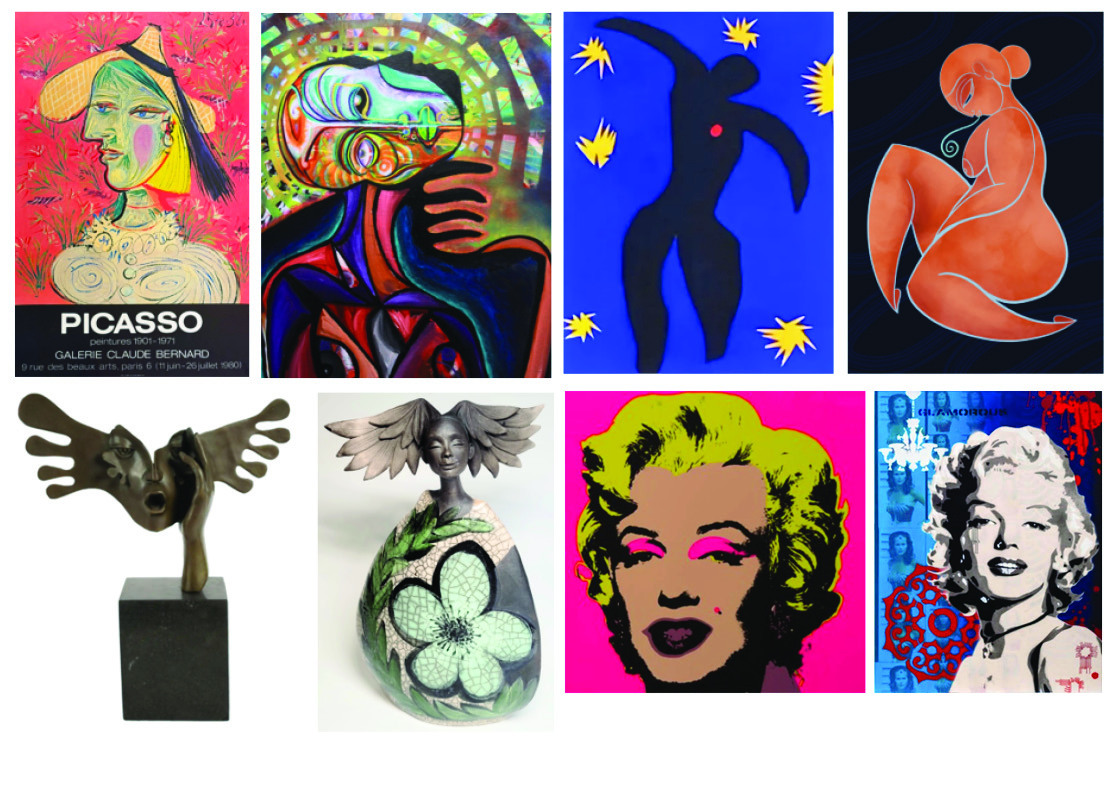
For centuries, artists have learned their craft by studying other artists. This year’s show brings together works by some of the biggest names in art history – think Warhol, Picasso, and Matisse (to name a few!), courtesy of Art by the River Gallery.
Discover how Art in the Park’s Kiwi artists absorb, bend and answer the ideas of the Modern Masters, and how you can collect both the masters and their contemporary counterparts at this year’s show.
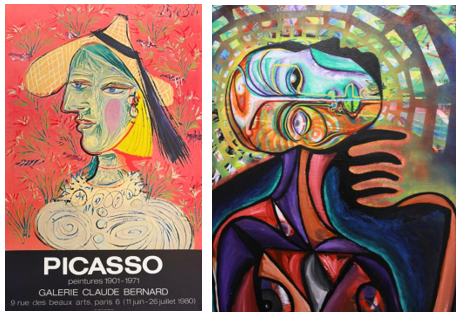
Picasso co-pioneered Cubism, showing a subject from multiple viewpoints at once rather than a single fixed one. His work is recognisable the world over, and he’s loved for challenging the way the world viewed art, showing that art didn’t need to be beautiful or realistic to be powerful, honest and important.
The two featured works share a lot. Heavy outlines divide the subjects and show stacked viewpoints, while contrasting colours support the fragmentation. Blue and red hues create emotion and decoration rather than realism. Rua’s work reads as a contemporary homage to Picasso, with some departures.
The biggest departure is intensity. Picasso’s palette is contained and subtle, while Rua’s is bright, highly contrasted and dramatic. She keeps the core elements of Cubism but makes it her own in a louder, more layered style – the Master’s influence is direct, but it comes out in her own voice.
Fittingly, you can see priceless Picasso masterpieces at the Auckland Art Gallery now, then purchase your very own Picasso at Art in the Park.
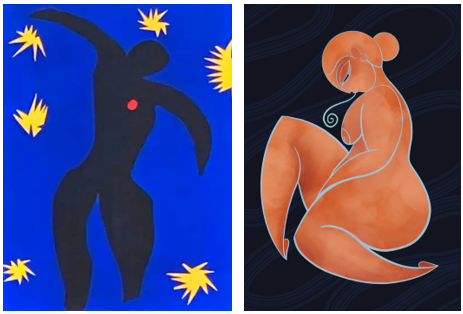
Alongside Picasso, Matisse transformed the art of the 20th century by changing how artists worked with colour, line and form. Like Picasso, he flattened his subject matter and created depth and harmony through planes of colour, pattern and shape.
In Matisse's Icarus, he reduces the human body to a single flat silhouette floating on a saturated background, letting go of perspective and detail in favour of contour, colour and rhythm. The work reflects the spirit of Fauvism, the movement Matisse co-founded, and his lifelong exploration of expressive simplicity. The influence on De Silva’s work is clear: her figure is a bold shape against a deep navy background, and her palette echoes Matisse’s use of contrast.
There is much about De Silva’s work that deviates from Matisse, and it brings in other well-known movements. The curves of her figure can speak to Art Nouveau, and her heritage sings through with a nod to South Asian Folk Art. The expression differs too; where Icarus is airborne, outward and dramatic, De Silva’s figure is curled inward and grounded. Rather than Matisse’s striking bold colour, De Silva’s mottled terracotta has a soft, watercolour-like quality. In these differences, De Silva celebrates Matisse’s use of line and form but explores it in a softer, more personal lens.
The swirling background lines add Matisse’s decorative patterning, with a dreamlike quality that is the artist’s own.
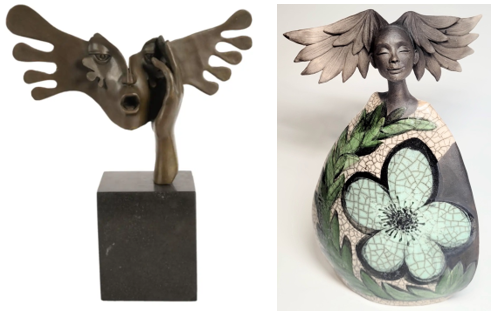
Salvador Dalí was a leader of the Surrealist movement, in which artists sought to unlock the unconscious mind, dreams and the irrational to challenge conventional reality through their work.
Both sculptures place a human head at the centre of a symmetrical, wing-like shape and blend the body with a distinctly non-human form, isolating the head as a focal point on a base. They converge in their expression of emotion and their signals of the unconscious mind, which place both works in the Surrealist tradition.
The works differ in spirit, however. In the Dalí inspired sculpture the face appears to be in shock or anguish, the hand becoming wings either side of it, cupping the face in a moment of possible pain while also escaping it. In Drummond’s work the wings appear to grow out of leaves emerging from the body, giving a sense of serenity and oneness with the natural world. The two works are entirely at odds in the experience they offer the viewer.
The medium differs too. The bronze casting in Dali’s style has a sense of permanence and strength, which contrasts with Drummond’s raku ceramic, where cracking and smoke-blackening make its fragility the point.
Dalí belongs to the avant-garde; Drummond’s work sits more firmly in craft lineage and fine art sculpture than in Surrealism, despite echoing some of its sentiments.
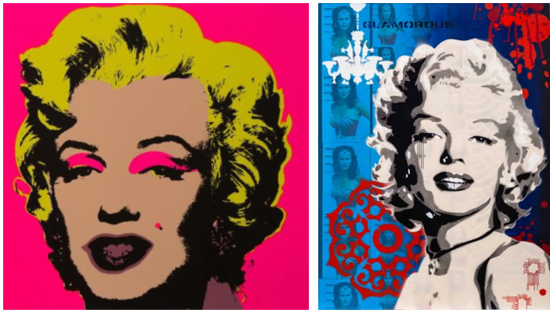
Andy Warhol is the most recognisable artist of the Pop Art movement and one of the most influential artists of the 20th century. Warhol challenged the definition of fine art, commercialising the process of creating and rejecting any emotional or spiritual meaning in his work. By repeating images and turning celebrity into commodity, he erased the boundary between high culture and advertising, offering a critique of our hyper-consumerist society.
Marilyn Monroe, depicted above by both Warhol and Art in the Park artist Brad Novak, shows this clearly. In both works she is not an individual sitter but an instantly recognisable icon, displayed with an almost poster-like quality. Both play on commercial visual language such as bold colours, repetition (although not in this Warhol piece) and commercial techniques like screen printing, but place that language in a fine-art context through exhibition, limited editions and hand painting.
The key difference is in the meaning each piece carries. Warhol’s single image screenprint relies on process to avoid symbolism, with slips between colour layers and flat colour resulting in a cool, detached image that doesn’t tell the viewer how to feel. In contrast, Novak’s work is a busier collage of repeated images and converging styles that blend Pop Art, Street Art and Comic-book Art. It presents a fragile woman, Marilyn Monroe, against Wonder Woman; an invulnerable icon, for a pointed contrast between fame and fantasy that guides the viewer to a specific reading of the subject.
Novak’s work offers clear commentary on Marilyn, and Warhol’s does the same, just more subtly. By using her image, both artists place themselves firmly in the Pop Art movement, focusing on a celebrity whose public life and media consumption transformed her from a private woman into a mass-produced commodity. Both emphasise the gap between Marilyn’s private and public personas, showing us front and centre the consumer image of a woman who was ignored for the person she was underneath.
Brad Novak exhibited alongside Warhol at an exhibition in Toronto in 2015, showing the Modern Master alongside his contemporary, Kiwi counterpart.
The Modern Masters provide us with a living conversation. Rua turns up the volume on Picasso’s Cubism, De Silva takes Matisse’s lines somewhere softer and more personal, Drummond finds serenity where Dalí found anguish, and Novak gives Warhol’s Marilyn a story to tell. Each Kiwi artist keeps the spirit of the master while making the idea their own.
You don’t have to choose between the masters and the artists they inspired. At this year’s show, courtesy of Art by the River Gallery, you can stand in front of works by these famous artists, then walk a few steps to see how Rua, De Silva, Drummond, Novak and many more of our exhibiting artists have answered them.
All the work at Art in the Park is available to collect, so you can take home your own piece of the conversation. Come with a favourite pairing in mind or let the comparison decide for you.